Part 1: The Gestalt
The ability to control two different effects is one of the joys of having multiple pedals or multiple effects. To date, I have focused most of my attention on switching between channels in a "parallel" manner. However, while doing research for the DBA sound saw and the Kill Kill Filter, it seems that users were interested in the ability to run one filter into another. The challenge ahead is how to develop a system which could accomplish at least 3 modes of operation (1) A into B, (2) B into A, (3) A or B, and (4) A and B.
Here's a version of a generalized schematic diagramof the switching systems we're interested in with. It should be noted that (1), (2), and (4) could use different grounding methods depending on your preference.

I have left off the LED switching systems at the moment for simplicity. Regardless, moving from (1) to (2) can be accomplished in a simple manner using the Geofex Juggler Effects Reverser.
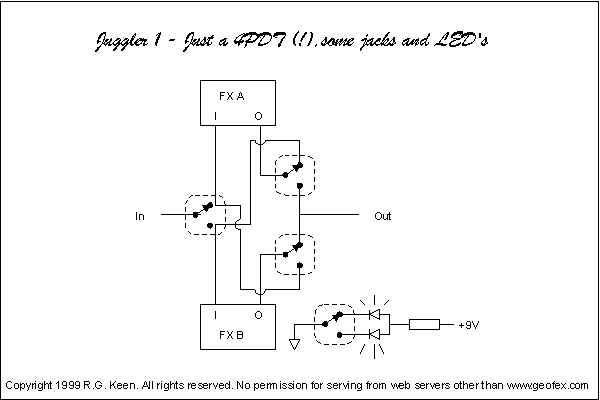
What we can see from this is that in addition to the Switching system to turn each effect ON and OFF, we require an additional 3 (or 4) SPDT switches to change the effect order.
So the challenge becomes mostly focused on getting between mode (3) and either mode (1) or (2). As well as getting to mode (4) and making sure that there aren't any phase issues. If we can draw out the paths to get between these modes, then its just a matter of a couple more SPDT switches to change the effect order.
Herein lies four of the starting challenges I've identified thus far:
A. The number of SPDT switches required.
We are already at 3 or 4 to just move between modes (1) and (2) NOT including the LED indication. Adding in mode (3), and it should be clear that there is probably not going to be an analog toggle switch or rotary switch which will be able to accomplish this switching. In addition, we will need a way to cycle through states in a relatively easy way.
B. Switch life time.
Part of the fun of the OR configuration is the ability to switch back and forth between effects/channels to quickly switch between different sounds. This will result in the "Channel Select" switch getting pressed more than the "Bypass" switch. Like everything, mechanical switches have a lifetime, can get worn out, and die on us, which present challenges with replacing them. Normally Open (NO) momentary switches have been used to toggle states of relays for pedals and can be used, but we'll need a way to address the toggled status of effects after power is disconnected. This is notably a problem in the OR mode.
C. CMOS switching and pop.
To accommodate the anticipated large number of switches, we'll likely need to use CMOS chips for switching. In my experience, there has always been a popping issue for me when I have breadboarded this. We'll need to include a form of muting system to prevent popping from being an issue when switching between the AND/OR modes when the effect is powered up.
D. Method of indicating which MODE we are in.
Switching between 4 modes, pretty much eliminates a single toggle switch (e.g. ON-ON-ON) to select the mode. I believe the choice is between (i) a rotary switch, and (ii) a push-button switch that cycles through the modes with some additional LEDs to indicate which mode is currently selected. I am leaning toward the pushbutton cycle selection since it is a new area for me to explore and doesn't take up as much space as a rotary switch. In my experience with Alpha Rotary switches (both plastic and metal) is that they stick up higher than the potentiometers, and often times require additional washers or an additional nut to get the right spacing/height with the inside of the enclosure. The issue with LEDs is finding the optimal way to communicate with the user which mode is currently active.
At the moment, the solution seems to be pointing toward a microcontroller-based solution. I'm pretty sure this switching system could be achieved to a degree without a microcontroller. But one of my goals for 2021 was to push myself in a different direction. I think that incorporating microcontrollers into my effects pedals will push me into uncomfortable territory but ultimately improve my creations.