Sunday, August 16, 2020

The Journey to New AND/OR...

 While looking over how to improve the functionality of the Receiver Operator. It has occurred to me that there are a bunch of routing options that could make this pedal incredibly versatile. I took a look out at other companies who create multi-channel pedals and noticed a "gap in the market". There are a number of ABY switches out there, Lehle, Earthquaker Devices, Morley, EHX, to name a few. All of these are outstanding pedals in their own right in terms of straightforward use, or options galore depending on what you are looking for.  However, I have yet to see a pedal which can do what I am looking for.

The RecOp and the pedals it was inspired by are known for their dual channel nature. Let's call this "OR", after the A OR B function of the operation.  This is an easy to implement function using a 3PDT switch, which is what the new J Mascis Fuzz from the previous post most likely uses. The next step in the evolution would be driving A into B, and naturally following that would be driving B into A.

These aren't ABY type of options, but they aren't that different. The AB component remains the same.  The Y option is not in question, although with the creation of one design, another is born. We'll tackle that at a later date.

So the three functional goals for this design are:

1. A "OR" B

2. A "INTO" B

3. B "INTO" A

Ideally, the end product would be simple enough to control with a 3-way toggle switch so that any body could drop this design into their DIY pedal and have a wide range of control over 2 different effects in the same box.  Similar to the 3PDT/4PDT order switcher boards out there.

At present the RecOp can do Notch "OR" Boost, I have figured a way to re-route the signal as Boost "INTO" Notch, but the effects are not independent. In this first draft of the INTO mode switch, the bypass button turns the Notch on (which makes sense since it is on the left hand side below the Notch controls), and the Select button turns on the boost, which then runs into the Notch. If we only toggle Select, it does not engage the boost section. it just lets us know that when we do turn on the Circuit, we will be slamming the notch with the boost. 

In my mind this is a cool feature, but it is not exactly where I want to go with this pedal.


The challenge at present is the number of SPDTs that have to be used and changing the LED indication status to reflect how the pedal is going to work. For the "OR" function I am partial to DBAs approach of having dimmed channel indication in bypass.  For the "Into" functions (if they work as independent units) I don't think dimming is necessary, but a tri-colored LED would be nice as a sort of visual cue to which mode you are in. Albeit unecessary, LEDs always make things neat.


So I'll try and do a better job about documenting how I implement this and get more shots of the breadboard up in the meantime too.


Friday, May 29, 2020

Switches & channels

Switches, either mechanical or digital, provide opportunities to route different part of the circuits around in some interesting ways.

To start, I have always been a fan of having two channels on pedals, something attracts me to that sort of design. Probably my early exposure in pedals to the DBA soundsaw and kill kill filter.


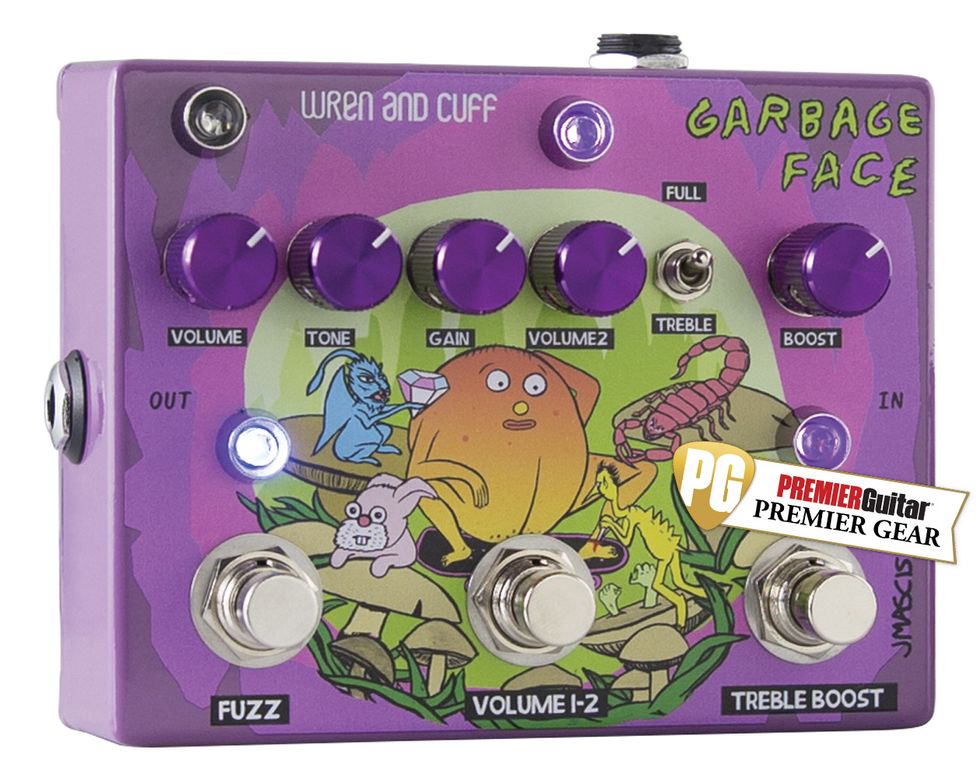
Recently, there is a Big Muff by Wren and Cuff ("Garbage Face")  that has been released which allows for two different volume settings for a channel.


I can't say for certain how they implement this, but if I had to guess it would be like the old Beavis audio, two pots on a stomp with an LED approach. http://beavisaudio.com/techpages/switches/

Not a bad approach at all! Easy to implement, minimum parts count and greatly expands the sonic pallete of a certain pedal.  In fact the DBA KKF uses this type of control, to change the tone potentiometer. Move this over to the potentiometer for gain, and you can have two channels which allow you to vary the saturation of your dirt circuit. All of this with a 3PDT switch (Stomp or toggle pick your poison)

If you don't care for the LED indicator, you could get by with the DPDT. But wait!!! What about other options.  As far as mechanical switches go, we can move up the the 4PDT. Which depending on how we want to implement it for channel switching, we could get creative and allow changes to be made to 3 controls of a circuit, but would need to isolate components so they don't interact across channels. I.e. the we don't want the volume control for channel one to change the volume of channel two. Digital switching systems are more complicated, but offer a longer life-span and the potential for more parameters of the pedal to be channel switched.  This comes at the cost of more knobs to interact with though. Digital presets are the next evolution which allow you to have the base number of potentiomers and the ability to cycle through "saved" states.  The challenge with this approach is not being able to see what the preset was.

The NEW DBA ROOMS pedal looks to have 3 channels switchable on their "ALT" footswitch. While there are large knobs for Frequency, Depth, and Time, there is also a smaller 9mm potentiometers for F, D, and T which I am going to guess is tied to the ALT footswitch.


This of course depends on how the potentiometer is oriented in the circuit to begin with. This is most ideal for potentiometers set up as voltage dividers.


This is brief post covering aspects of mechanical switches for "multi channel" modifications to your pedal, but also serve as a backdrop to part of the process going into the Sound Saw REMAKE. The pedal toggles back and forth between the boost and the filter sides of the circuit.


Saturday, May 16, 2020

Thoughts on the SoundSaw

Hey team,
 Glad you could join me, now let us begin.

SOUND SAW
what was the deal with that pedal anyway? Crazy awesome sounding demos on the old DBA website, but they are hard to come by and there is one schematic that has been floating around for years now.

Back in 2014-2016ish, I was helping Glass Hero screen some enclosures with the Sound Saw artwork until he disappeared (hope all is well). It was about that time that my life got complicated and I had to put a lot of things on hold and move states to a new job, now after moving to another state for another job, I feel like building pedals again. I have been ever so slowly unpacking my tools and reviewing old schematics I had drawn up to try and start being a little more efficient with my design process.

Part of this process is putting out a SOUND SAW REMAKE. I am looking at the instruction card from the original and tasking myself to recreate a pedal like this. Something that has the same functionality, but with improvements based on my knowledge thus far and what I would want, and something that adds to the original

After looking through the forums and customer reviews and feedback, I hope to incorporate those ideas and create an excellent REMAKE.  At the end of the day, I will probably email Oliver the results of my passion project and send him my REMAKE.

I have sent off for PCBs to test the backbone circuit of the pedal.


From here I will be developing the upgraded (deluxe) variant of the pedal.

I would really like to dig into some programming to make this process incorporate a challenge of a different dimension. Another reason is the relatively short foot switch lifespan of mechanical bypass pedals. With a pedal which you can toggle channels for huge variations in sound, a foot switch will most likely get plenty of use.  Once it is all used up, what is the customer left with? a dead foot switch. Let's try and avoid that from here on out.

I'll keep you all posted as I move forward with this project.

After this I can get around to....reverb pedal REMAKE.

Best regards

Friday, April 3, 2020

Solaris reverb, feedback, and diagrams: Where the past listens to the future

"Where the past listens to the future"

In directed acyclic graphs, one of the defining rules is that a variable cannot cause itself. In "reciprocal" chicken or the egg situations the question needs to be depicted by indexing variables by time.

   Without diving too deeply into my growing elementary understanding of analytic methods for causal inference, I always come back to schematics and feedback paths in schematics. The state variable filter is a design that has always interested me, and Beavis Audio Flaming Howl of Death mod for the fuzz face was another crazy example.  Basically tapping a connection at some point after the circuit input and connecting it back to the input. This creates a feedback loop in which the signal is fed back into itself for chaotic results.

With delay and reverb type of circuits, the output of the affected signal can be fed back to the input of the signal to create some fun results. In delay circuits this achieves the "repeats", in a reverb circuit this regeneration of the signal creates a deeper reverb that migrates towards self oscillation.

I plan on revisiting the Solaris reverb and making modifications to the circuit that are informed by my experimentation and understanding of time-based effects as well as making some modifications. 

My goal is to maintain the character of the source material, but to put more of my spin on it.
This includes a modification to the affected signal, the feedback control, and the bypass signal. One of my personal issues with some time based effects is the use of mechanical 3pdt true bypass switching.  This can result in a ridiculously loud echo for the popping of the mechanical switch.  Sometimes this can be cool, other times it can be annoying if you are trying to "ease" into a part. 

I'll keep posting my progress and thoughts about this reverb project as we continue along this year.

Sunday, January 12, 2020

Madbean 2019 POTY contest entry


As I am getting back into pedals this year, i only successfully built one... Ha, so this was an easy choice. Definitely learned a lot about how not to do things, so hopefully this next year is a productive one with more choices for me to choose from.


\

Some gut shots were shown before, but this is a little closer and a little bit more tidy :)
I will try and post more on the blog this year, as I keep people posted on what I'm working on, and my thoughts, etc.
Best, 
   Bradford1

Thursday, November 7, 2019

DREAMEATER Dark Sun

I'm back!!!

After a whole lot of life happened, I have found relief back in my hobby of building electronic guitar pedals.  

To start back up, I decided I would take on the long drawn out battle I have had with the 7 transistor Fuzz War by Death By Audio.
This pedal has always interested me and I loved the sound every time I would start building it on the breadboard. Problems would arise however, whenever it came time to complete the circuit and there would be strange pedal properties or problems that were encountered.  


Also there was a skeptical issue regarding the schematics that were floating around. So this time around I cracked open the pedal myself and started to trace it out only to discover that the circuit was different from the designs floating around.


So I messed around with it on the breadboard and made some improvements based on all that I have learned all this time that I've spent on websites and forums. and voila!!! 


The sound I have been looking for and a more stable 7 transistor design that overcomes issues with the "original" V1. I say original because apparently there were multiple versions of the 7 transistor design before they transformed the pedal into "yet another big muff" type of circuit.

1. Louder output volume
2. External gain knob
3. Added tonal options
4. Gating incorporated into the design


The prototype


Back at screen printing...

Assembled pedals...


Pedal promotions on my kitchen counter with some duo chromatic bags for the duo chromatic pedals...


I put some youtube demos together, I'm still learning how to put a video demo together that doesn't use the phone audio, I think I can synch up the timing with a video and the recording from my DAW.

Oh well, in the meantime at least there isn't a foot in the video.

Enjoy

Bass
https://youtu.be/b8LStLAE1cw

Guitar
https://youtu.be/WM2y8F8FtZo

In the context of a Song
https://youtu.be/uoUQD6ly9qI

Sunday, September 24, 2017

Solaris

Solaris, based on the sunshine reverberation by DBA, which appears to be a digital rendition of older tube based reverb tanks.  Definitely a cool sound!